OldTimePreaching.comA ministry of the preached Word
“Preach the Word... in season and out of season.”
The Holy Scriptures   /   American Standard Version (1901)
American Standard Version · 1901

Acts 17

American Standard Version (1901) · Public domain

1Now when they had passed through Amphipolis and Apollonia, they came to Thessalonica, where was a synagogue of the Jews: 2and Paul, as his custom was, went in unto them, and for three sabbath days reasoned with them from the scriptures, 3opening and alleging that it behooved the Christ to suffer, and to rise again from the dead; and that this Jesus, whom, [said he], I proclaim unto you, is the Christ. 4And some of them were persuaded, and consorted with Paul and Silas; and of the devout Greeks a great multitude, and of the chief women not a few. 5But the Jews, being moved with jealousy, took unto them certain vile fellows of the rabble, and gathering a crowd, set the city on an uproar; and assaulting the house of Jason, they sought to bring them forth to the people. 6And when they found them not, they dragged Jason and certain brethren before the rulers of the city, crying, These that have turned the world upside down are come hither also; 7whom Jason hath received: and these all act contrary to the decrees of Cæsar, saying that there is another king, [one] Jesus. 8And they troubled the multitude and the rulers of the city, when they heard these things. 9And when they had taken security from Jason and the rest, they let them go. 10And the brethren immediately sent away Paul and Silas by night unto Beroea: who when they were come thither went into the synagogue of the Jews. 11Now these were more noble than those in Thessalonica, in that they received the word with all readiness of mind, examining the scriptures daily, whether these things were so. 12Many of them therefore believed; also of the Greek women of honorable estate, and of men, not a few. 13But when the Jews of Thessalonica had knowledge that the word of God was proclaimed of Paul at Beroea also, they came thither likewise, stirring up and troubling the multitudes. 14And then immediately the brethren sent forth Paul to go as far as to the sea: and Silas and Timothy abode there still. 15But they that conducted Paul brought him as far as Athens: and receiving a commandment unto Silas and Timothy that they should come to him with all speed, they departed. 16Now while Paul waited for them at Athens, his spirit was provoked within him as he beheld the city full of idols. 17So he reasoned in the synagogue with the Jews and the devout persons, and in the marketplace every day with them that met him. 18And certain also of the Epicurean and Stoic philosophers encountered him. And some said, What would this babbler say? others, He seemeth to be a setter forth of strange gods: because he preached Jesus and the resurrection. 19And they took hold of him, and brought him unto the Areopagus, saying, May we know what this new teaching is, which is spoken by thee? 20For thou bringest certain strange things to our ears: we would know therefore what these things mean. 21(Now all the Athenians and the strangers sojourning there spent their time in nothing else, but either to tell or to hear some new thing.) 22And Paul stood in the midst of the Areopagus, and said, Ye men of Athens, in all things I perceive that ye are very religious. 23For as I passed along, and observed the objects of your worship, I found also an altar with this inscription, TO AN UNKNOWN GOD. What therefore ye worship in ignorance, this I set forth unto you. 24The God that made the world and all things therein, he, being Lord of heaven and earth, dwelleth not in temples made with hands; 25neither is he served by men’s hands, as though he needed anything, seeing he himself giveth to all life, and breath, and all things; 26and he made of one every nation of men to dwell on all the face of the earth, having determined [their] appointed seasons, and the bounds of their habitation; 27that they should seek God, if haply they might feel after him and find him, though he is not far from each one of us: 28for in him we live, and move, and have our being; as certain even of your own poets have said, For we are also his offspring. 29Being then the offspring of God, we ought not to think that the Godhead is like unto gold, or silver, or stone, graven by art and device of man. 30The times of ignorance therefore God overlooked; but now he commandeth men that they should all everywhere repent: 31inasmuch as he hath appointed a day in which he will judge the world in righteousness by the man whom he hath ordained; whereof he hath given assurance unto all men, in that he hath raised him from the dead. 32Now when they heard of the resurrection of the dead, some mocked; but others said, We will hear thee concerning this yet again. 33Thus Paul went out from among them. 34But certain men clave unto him, and believed: among whom also was Dionysius the Areopagite, and a woman named Damaris, and others with them.
Historical study companion

Reading Acts 17 in context

This study accompanies the chapter; it does not replace the Scripture text above.

Study overview

Acts 17:16–34 describes Paul reasoning with people in Athens and speaking before an audience associated with the Areopagus. The text is the primary account. Historical sources help explain the city's public spaces and religious setting, but they do not identify the exact place of the speech or prove the event.

Study notes

A public city and a debated setting

Acts places Paul in the marketplace and then before the Areopagus. Areios pagos can refer to the rocky hill or to the council. Scholars have proposed both the hill and a council setting in the Agora; the exact venue is not settled, so the map distinguishes places from claims about where the speech occurred.

Acts 17:19–22

The Stoa Basileios proposal

The Stoa Basileios stood at the Agora's northwest corner and is described by the Foundation of the Hellenic World as the seat of the Archon Basileus, with religious and juridical duties. Hemer discusses the stoa as one possible council setting. Neither source establishes that Paul's speech happened there.

Acts 17:19–22

The “unknown god” and the limits of archaeology

Acts 17:23 reports Paul's reference to an altar inscribed “To an unknown god.” Pausanias, writing in the second century, mentions altars of unknown gods near the harbor at Phalerum. That later passage is not evidence for an altar on the Areopagus or in the Agora. No surviving object has been verified as the specific altar in Acts.

Acts 17:23

Explore Athens

The interactive Leaflet map loads when JavaScript is available; the complete place descriptions remain readable below. Map data and tiles © OpenStreetMap contributors. Tiles require an internet connection.

Markers identify approximate landmarks, not the exact site of Paul's address. No walking route is claimed.

Photographs & historical context

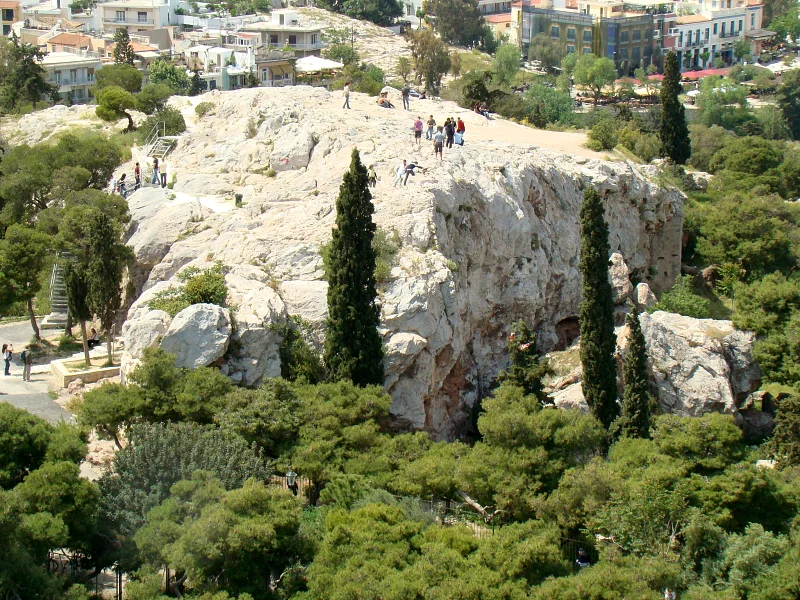
The rocky Areopagus hill in Athens, photographed in 2007.

The Areopagus hill today

Location: Athens, Greece. A modern photograph of the rocky hill traditionally associated with Paul's Areopagus address. Acts can refer to the council as well as the hill; this photograph does not establish the precise venue or the spot where Paul stood.

Photograph date: 25 April 2007

O.Mustafin, via Wikimedia Commons · CC0 1.0 — public domain dedication

Changes: Converted from JPEG to WebP; no content alterations.

Original photograph source record Acts 17:19–22
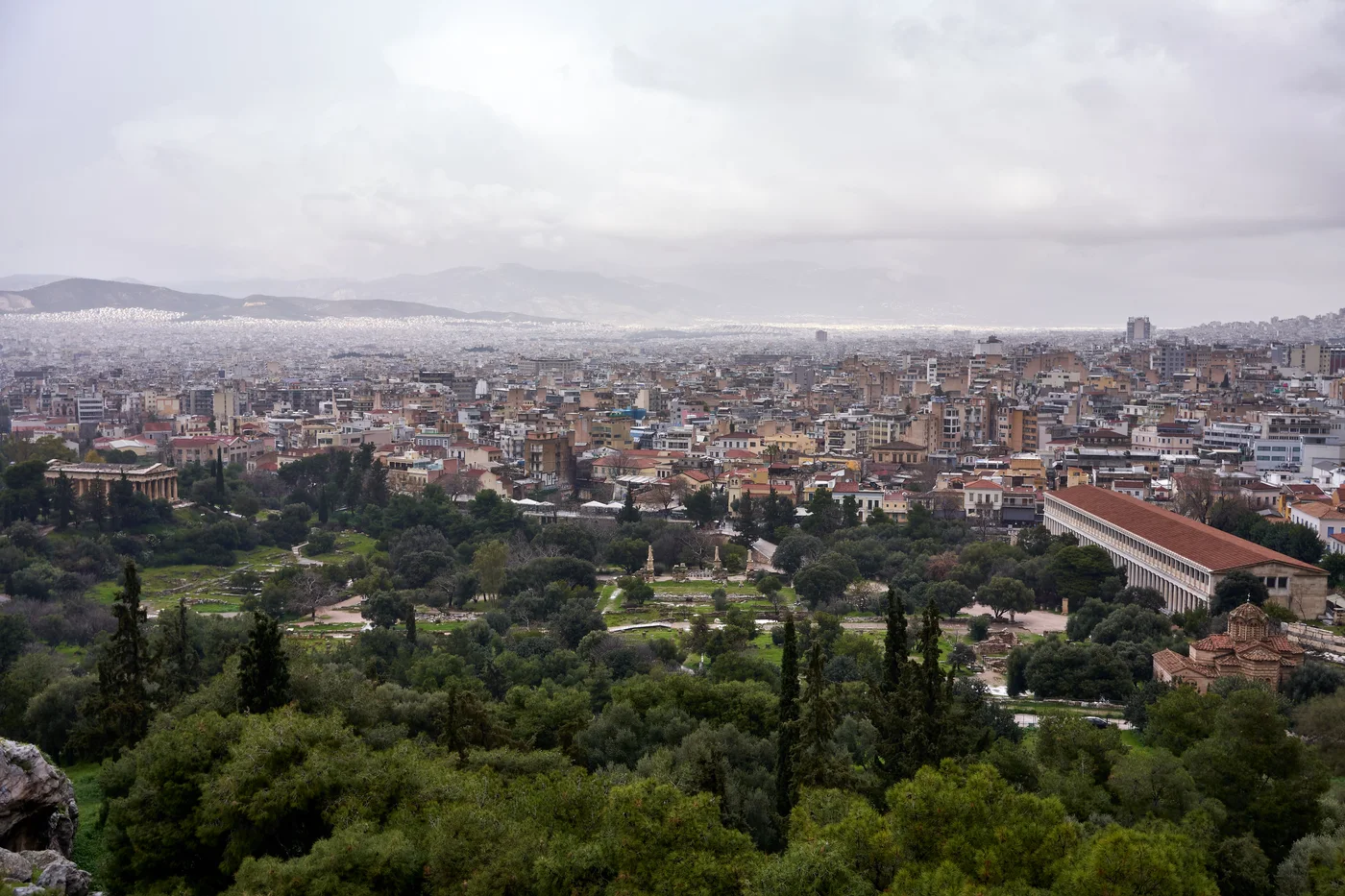
Panoramic view of the Ancient Agora in Athens with the Temple of Hephaestus and reconstructed Stoa of Attalos.

The Ancient Agora from the Areopagus

Location: Ancient Agora archaeological site, Athens. The excavated civic center helps explain the marketplace in Acts 17:17. This modern view includes remains from different periods and the Stoa of Attalos reconstructed in 1953–1956; it is not a reconstruction of the city in Paul's day. ASCSA's excavation overview documents the site's civic role and modern restoration.

Photograph date: 6 February 2019

George E. Koronaios, via Wikimedia Commons · CC0 1.0 — public domain dedication

Changes: Resized to 1400 × 933 pixels and converted to WebP; no content alterations.

Original photograph source record Acts 17:17
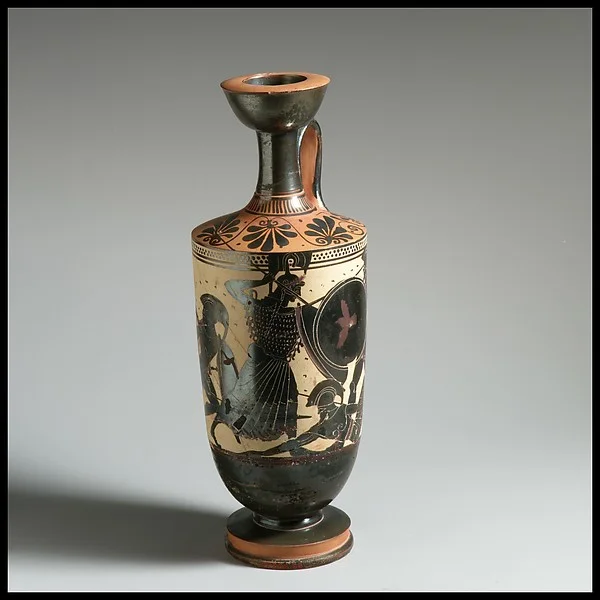
Terracotta lekythos with a black-figure battle scene including Hermes and Athena on a white ground, Met object 07.286.68.

An Attic oil flask depicting Hermes and Athena

Object: terracotta lekythos (oil flask), Greek, Attic, first quarter of the fifth century BC; attributed to the Athena Painter. The Metropolitan Museum of Art, New York, accession 07.286.68, Rogers Fund, 1907. The museum identifies the scene as the battle of gods and giants, including Hermes and Athena, and relates this vessel type to Athenian funerary rites. This much earlier object illustrates religious imagery, not a first-century find, an object Paul saw, or the altar in Acts 17:23.

Photograph date: Photograph date not supplied in the museum record

The Metropolitan Museum of Art, Rogers Fund, 1907; individual photographer not specified · CC0 1.0 — The Met Open Access

Changes: Converted from the museum's JPEG to WebP; no content alterations.

Original photograph source record Acts 17:16 Acts 17:23–25

Objects & evidence

Council dedication to Aphrodite Hegemone and the Graces

Attic Inscriptions Online records IG II³ 4, 8 as a dedication by the Council to Aphrodite Hegemone and the Graces. Its date is given tentatively as 191/0 BC, and the monument type is listed as an altar. It is evidence for a named civic dedication, not the altar described in Acts 17.

Photograph placeholder

No photograph is included. Add one only after its object identity and reuse permission are checked against the cited inscription record.

View object source record

Aphrodite Ourania altar

An altar excavated in the Agora in 1981 was attributed to Aphrodite Ourania and dated to about 500 BC. It is evidence for an earlier Athenian cult site, not an identification of Paul's altar. No reusable photograph was verified for this object.

Photograph placeholder

No photograph is included. The cited excavation report supports the object description; no reusable image has been verified.

View object source record

Related OldTimePreaching.com sermons and reviews

No relevant existing sermons or reviews have been verified for this chapter, so none are listed.

Historical notes distinguish documented evidence, traditional identifications, scholarly proposals, and unverified claims. No surviving object has been verified as the specific altar in Acts 17:23.