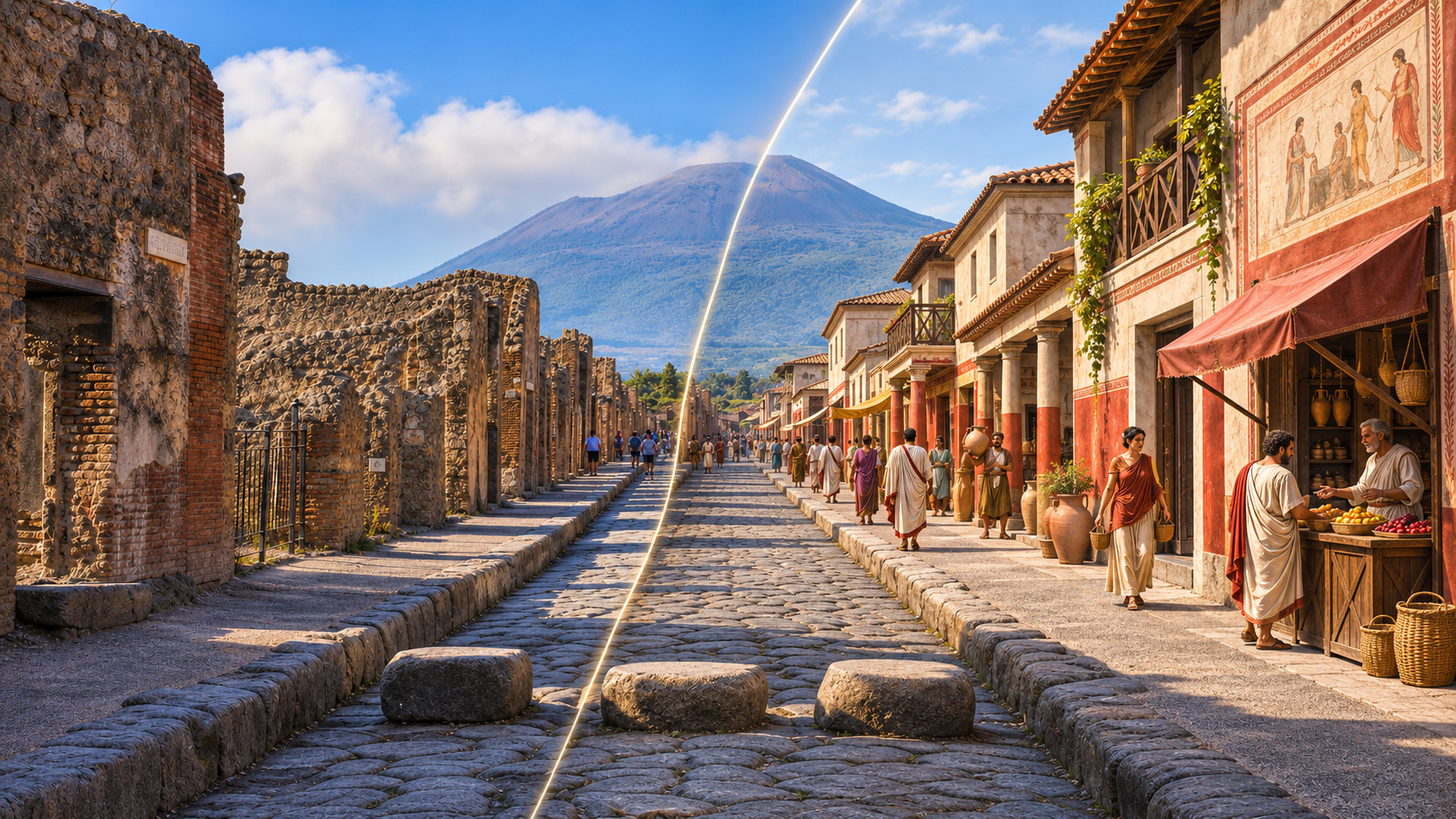
Imagine a morning in Pompeii. Cartwheels knock against the stones of a narrow street. A bakery's millstones are turning. Someone is negotiating over a purchase; someone else is writing a message on a wall. Above the town stands Mount Vesuvius, familiar enough to be almost ignored.
It is the first century. Rome rules the Mediterranean. In Judea, Jesus of Nazareth has been crucified under Pontius Pilate; His followers now proclaim that God raised Him from the dead. The message is travelling farther than anyone standing on a Pompeian street might suspect.
Did anyone in Pompeii hear it? Did a believer ever walk these stones? A few extraordinary archaeological clues take us close to the answer—but not quite all the way.

Before the Ash: Paul Comes to the Bay
To understand what may have happened in Pompeii, begin not with an inscription, but with a harbour. Around AD 60, the Apostle Paul arrived in Italy on his journey to Rome. Acts says he reached Puteoli, a busy port on the Bay of Naples.
“And we came the next day to Puteoli: Where we found brethren, and were desired to tarry with them seven days: and so we went toward Rome.” Acts 28:13–14 (KJV)
Luke does not say that Paul entered Pompeii. That would be an invention. But he tells us something every bit as striking: there were already Christians living in this region. The gospel had travelled to the Bay of Naples before the imprisoned apostle arrived.
Between Puteoli and Pompeii, people traded goods, travelled for work, visited family, and passed news. A merchant might have told a friend about Christ. A traveller might have heard of the resurrection. We cannot recover any particular conversation, but the roads and sea routes were real—and so were the believers whom Paul met.
A Bible Story on a Pompeian Wall
One house in Pompeii, known as the House of the Physician, contained a fresco often interpreted as the Judgment of Solomon. The scene evokes the account of two women who came before Israel's king, each claiming the same child.
“Give her the living child, and in no wise slay it: she is the mother thereof.”1 Kings 3:27 (KJV); read the whole account

This painting does not prove that a Christian lived in the house. Indeed, an ancient artist could borrow the tale as an interesting scene without sharing its religious convictions. Yet the painting offers a glimpse of how stories associated with the Hebrew Scriptures could move through the Roman world.
Paul regularly reasoned from those Scriptures that the promised Christ had suffered and risen again. See Acts 17:2–3. The fresco is not evidence of that preaching in the house; it shows why we should be cautious about assuming the city's inhabitants knew nothing of Jewish traditions.
A Cross in a Bakery—or Just a Tool?
Walk into a Pompeian bakery and the first thing you notice is how ordinary everything is. Stone mills stood where grain was ground; ovens were built for a daily necessity. Among the city's old bakeries, one mark was once read as a Christian cross. The place acquired a reputation as a “Christian bakery.”

But another explanation is possible: what looked like a cross may have represented baking equipment. We cannot call the baker a Christian simply because two lines intersect. A desire to find evidence must never become a substitute for evidence itself.
The Most Intriguing Clue: “Christians” on a Wall?
In 1862, excavators recorded a graffito in Pompeii that later entered the catalogue of Latin inscriptions as CIL IV 679. Its wording is disputed, but several scholars believe it contained a form of the word Christianos or Christiani—“Christians.”
If that reading is correct, it matters enormously. The writing had to predate the city's burial in AD 79. This would put a reference to Christians on an ordinary Roman wall in the same century in which the apostles were preaching.
Cook concludes that there are good grounds for believing the word was probably present. That does not establish the complete translation sometimes given in popular accounts—or prove that a Christian actually occupied the room. The inscription may be evidence of knowledge of Christians, not proof of a local congregation.
Even so, open the Book of Acts and notice something important:
“And the disciples were called Christians first in Antioch.”Acts 11:26 (KJV)
The name was not invented centuries later. Whatever the Pompeian inscription eventually proves, Acts already places that name in the apostolic era.
A Name That Could Bring Ridicule
Suppose a visitor to Pompeii did mock Christians in a lodging house. What would he have been mocking? Christians worshipped Jesus Christ, crucified by Roman authority, and refused to treat the empire's gods as true gods. To some Romans this faith appeared foolish, disruptive, or suspicious.
“For the preaching of the cross is to them that perish foolishness; but unto us which are saved it is the power of God.”1 Corinthians 1:18 (KJV)
Peter told believers that even suffering under the name “Christian” need not bring shame (1 Peter 4:16). The New Testament allows us to understand why an insult, if correctly interpreted as one, would fit the world in which the early church lived.
Could Another Mark Have Said “He Lives”?
Another contested Pompeian graffito has been described as a possible cross with letters interpreted as vivit—Latin for “he lives.” It is easy to see why a Christian reader finds the thought moving. Christ died on the cross, and the apostles proclaimed His resurrection.
But intersecting scratches are not automatically a cross, nor are damaged letters securely read as vivit. We should not claim a clear resurrection inscription where the physical evidence is unclear.
“Knowing that Christ being raised from the dead dieth no more; death hath no more dominion over him.”Romans 6:9 (KJV)
That conviction was certainly preached by the apostles. Whether it was scratched onto a Pompeian wall is a separate, unresolved question.
Then the Mountain Erupted
In AD 79, Vesuvius erupted. Ash and pumice fell on the streets. Roofs collapsed under the accumulating weight; violent, deadly flows of ash and hot gases later overwhelmed parts of the region. Ordinary journeys, meals, and arguments ended in catastrophe.
Pompeii was covered, and many details of its everyday life were preserved. Archaeologists can still trace streets walked by workers, tools used by bakers, and writing left by residents and visitors.

Were Christians among the dead? We do not know. The Bible places believers in nearby Puteoli, and the disputed graffiti may indicate that people in Pompeii knew the name. We cannot go beyond that evidence and give a fictional martyr a real name.
The Buried City and the Living Gospel
Today, Pompeii is unsettling precisely because it is so human. A street seems ready for footsteps; an oven seems ready for bread. The people who used them, however, are gone.
“For what is your life? It is even a vapour, that appeareth for a little time, and then vanisheth away.”James 4:14 (KJV)
The city was buried. The gospel was not. The message carried by the apostles continued beyond the first century and is proclaimed today: sinners are saved by God's grace through faith in Jesus Christ, not by works or religious merit (Ephesians 2:8–9).
Archaeology can reveal where people walked and what they wrote. It cannot, by itself, tell us whether a particular soul believed in Christ. Nor does the authority of Scripture depend on a damaged inscription. Yet these small material traces make one point unforgettable: Christianity arose among real people, in actual towns, during the living history of Rome.
Perhaps someone in Pompeii knew the name of Jesus. Perhaps someone there believed. The evidence invites us to investigate—but also to know the difference between a fascinating possibility and an established fact.
Sources, Bible References & Photo Credits
- John Granger Cook, “Christianos in CIL IV, 679: The Possibility of an Image,” New Testament Studies (2024). The principal recent study of the disputed graffiti.
- Bruce W. Longenecker, The Crosses of Pompeii: Jesus-Devotion in a Vesuvian Town (2016), publication details. A more expansive case for possible Christian presence.
- Judgment of Solomon fresco, Naples National Archaeological Museum, inv. 113197.
- Biblical passages: Acts 28; Acts 11; 1 Corinthians 1; 1 Peter 4; Romans 6; James 4; Ephesians 2 (KJV).
Photographs of actual archaeological artifacts and sites are credited alongside each image. The article banner is a modern photograph combined with an artistic reconstruction supplied for this article; its right half must not be confused with documented ancient architecture. The archaeological images are remotely hosted by Wikimedia Commons and require internet access.
Historical note: The opening street scene uses imaginative descriptions of ordinary Roman life, not fabricated quotations or identified eyewitnesses. The article distinguishes confirmed biblical and archaeological evidence from disputed interpretations.